January 31, 2005

route finding


Above Lago Azul

My other recent trip was an exploratory excursion into the box canyon of Azul Lake, looking for an ideal place to take hikers that wanted to earn birds’ eye-views through sweat. I was set to take two friends from the states, Stephen and Tara, along with fellow guides Cathy and Fernando. As fate would have it a terrible stomach flu claimed Stephen, and Tara as nurse nightingale, so the group was whittled down to three.

But we still had the gear (read: elaborate gourmet food and camp accessories) for five, or perhaps for eight. We hiked the perimeter of the lake on an old trail almost never used. The spiky brush of rosehips and hazelnut bushes and other plants had reclaimed the trail. We had to breaststroke our way through the underbrush, if one had worn shorts it would have been occasion to cry with all the needles and spines grazing our legs. As it was, the conversation was reduced to “ooh” and “ow.”

The next segment of the hike was up, straight up, at a merciless angle. But here there was an established trail, a good one, since livestock climbed these valleys in winter to forage for food. These were the so-called “wild cows” we stumbled upon, or, “spy cows” who gazed at us through thick forest brush and bolted like frightened sparrows at the sound of a snapping branch. All the while we lamented the absence of Stephen and Tara, who would have provided good humor and extra cliff bars.

The valley we climbed into was not the flat, high altitude basin I had imagined, but instead, a long steep walled forested canyon that ended in a wall of formidable peaks: the Argentine border.

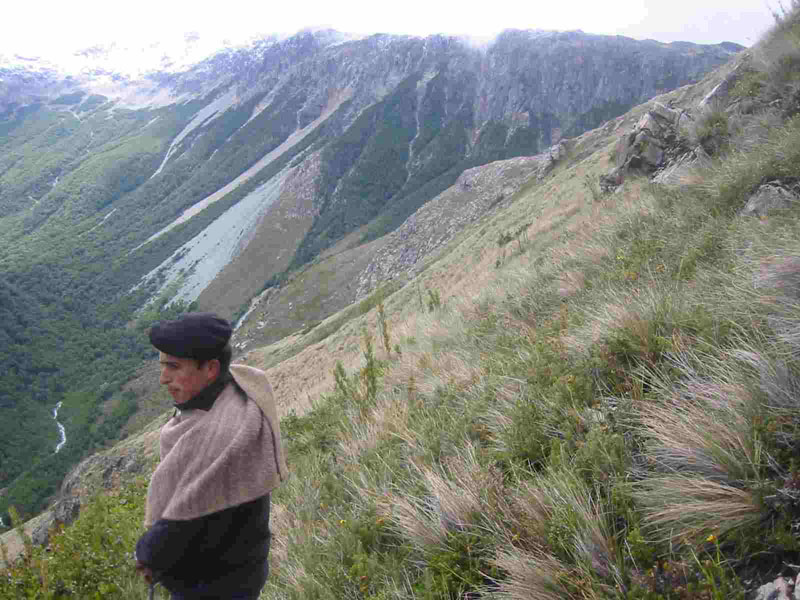
The next day, while it spit snow and hail, and the clouds banked low on the peaks, we had a look around the upper reaches on the only accessible mountain, which had burned in years past and now had short grass instead of forest. From up there we could see Lake Azul and the waves of mountain ridges behind it. The wall of Argentina still stood before us like a fortress, but now it seemed we had earned half its height. The trouble was getting down. We went route-finding, which is to say, wandered toward the back of the mountain, slipping all the while in the coarse, wet grass, before descending into thick brush that threatened to swallow us whole, or, mercifully, claim an ankle. Wading though the plants my boots absorbed water until it felt like I had sponges under my rotting feet.

To sum it up, Fernando, a local 20 yr. old, who ached for a military career and herded sheep and cattle all his life, said, “I never want to walk this way again.”

I wasn’t so sure. We heard of another local who has ranched and shepherded and knows the valley well. He says there is a better trail which leads up to the border, and he’ll take us there. I have gone to the pharmacy, undergoing the initial embarrassment of asking for a cream to cure the mushrooms on my feet (literal translation). They’re starting to heal up nicely. And once again, though half the time these trips result in uncertainty and mild torture, I find that I ‘m tempted.

These places will never lack adventure, they will always have places to explore, secrets to find. The cows know. I have a feeling, the way they eyed me suspiciously. And they want their secret kept.

the hidden valley

It seems like for the past year I have been treading the rural backwater, so to say that I’ve hit the furthest-flung reaches might sound redundant. But it’s not.

I had heard about Ventisquero (the hanging glacier) Valley for some time. I tried to go twice but was foiled. First in September by a horse accident, and second in December by a travel partner unwilling to trod the eleven hours in on foot. A local claims that the valley is bewitched and “mañoso,” picky: not letting just anyone enter, and sometimes keeping travelers at bay for weeks with storms and swollen rivers. In short, it sounded to me like the kind of place where folktales and fairytales were still being manufactured.

This time I took my time and contracted a local guide, the only who would agree to hoof it (walking is second class, riding is first). Still, we traveled with a packhorse to carry provisions and cross rivers with. We set out on a blazing hot summer day, horseflies swarming us as we made our way up valley.

My final destination, reached a few days later, was the ranch of Don Leonidas, age 79. He was the last of the old school of cowboys, arrived as a child in the valley and was brought up making a home out of the wilderness. When he was 22 he rode to Argentina to get a wife, and while before he was suspected to be a bandit, these days he is a local patriarch, the guy they send to the grade school once a year to tell the kids about the old days.

When I asked if I could tape him he took one sidelong glance at my silver recorder and asked how could he be sure it wasn’t a pistol. Sometimes being five foot tall and minimal works to your advantage. I just shrugged.

All the while an orphan sheep cried in the background (if they are bottle nursed they resist weaning and follow their owner around like a lapdog) and Doña Licha told me about her own milk miracle. When her daughter abandoned her granddaughter at their house she was able to breastfeed her, up until the sturdy age of eight. Doña Licha must be Ventisquero’s patron saint of dairy, she also showed me a separate hut where she makes cheeses and offered me a chunk of the mild stuff (like munster”), wrapped in an old plastic food wrapper, to bring home.

A gracious host, she hasn’t been out of the valley in at least twenty years (unlike her husband, who rides to town once a week). She says she won’t either, because she can’t get on a horse because of a hernia. When asked if she’d have it operated on, she replied in her baritone voice, “For what? Just let it be, I should be dying soon enough anyhow.”

On my second day their great grandchild, known as Juanito Accordeon (little Juan accordion) emerged from the attic, painfully shy but bribed by his great-grandma to play a few songs for a candybar. His instrument is an antique that he’d picked up lying around the house, and the keys stick in the humidity, making his little brow furrow.
Juanito plays accordion and guitar, mostly Mexican rancheras, and is seven years old. Doña Licha danced and slapped her thighs. The accordion appeared to crush Juanito, his two spindly legs sticking out, but he played with gusto, with the rapidity of a field mouse darting hole to hole. Juanito is the kind of kid that doesn’t talk unless it’s through an instrument, and then does so beautifully.

I have plans to go return to the valley in March, to get more stories and more cheese.