Showing posts with label Puelo. Show all posts

April 9, 2007

The Mother of All Mothers

part III

We leave the valley passing by Lolo's cabin. It's most outstanding feature is his eighty-three year old mother, Audelia. More than the rest of the family, she loves a visitor. On a brisk day she layers her best summer dresses over each other, puts on bangles and earrings and hopefully remembers to put in her hearing aid.

She holds visitors hands, pats them, smiles. This can last hours. For those unaccustomed to touch, it can be disconcerting.

"When are you coming back?" she asks. Even if you've just arrived.

The question flummoxed Tara, who was probably thinking to herself the chances were indeed slim. But how do say this when your host emptied her jewlery box to greet you?

Given, Doña Audelia is hard to understand. She speaks in a murmur. Her words step over her daughter's. They come confident and swift. Snatches of stories grab me--that her father was a huesero (a bone healer) or that she used to grind the grain racing horses in circles to crank the mill. She was once the fastest rider of all her siblings. Now she's the only one. Only one other family lives further up valley. Visits are scarce.

And though I can barely understand her (sometimes her daughter will shout translations) I'm fascinated. What other stories remain?

She putters around on a cane decorated with crochet. She eats well. She drinks three cups of powdered juice with lunch. "You'll get drunk!" teases her husband. She ignores him. I find myself wondering, who was this plucky woman as a girl? How did she survive with her tenderness intact?

The family is united around the fire. "Mom, we're selling you to the foreigner," Lolo shouts, hugging her.

"Bueno," she concedes.

Who knows how long this will go on? I tell her I'm coming back soon.

April 2, 2007

Patagonia via the back door


part one: going local

We were trekking to the glacier in Lolo Escobar's backyard on a trail he created with a hand-axe. That in itself seemed incredible. Patagonia’s backyards feature few swingsets but some include a thorny wilderness inviting adventurers to get hopelessly lost. That’s why you go with a local.

Among even them, Lolo is considered an anachronism. Compact and quirky, we can say he’s serious and sincere but not above a prank. He helps run the family ranch, carves ingenious animal shapes from discarded roots and studies the Guide to Native Plants and the Bible. Given his scant contact with the outside world, it doesn’t seem incongruous to call himself both ecologist and evangelist.

My friend Tara is an experienced hiker, so I found her aghast watching as the pack horse was saddled with 60 kilos to head up the mountain for a few days. She had already cocked a brow when Lolo’s sister packed us glass jars of honey, four kilos of breadrolls, homemade fruit preserves and marmalade. But we did stop her short of including a whole raw leg of lamb.

At these times, I remind myself that we live under local norms here, not modern ones, and are mostly content for it. It helps too to remember that people of this valley died of hunger in not-so-distant past. Thus these hulking grain sacks amounting to a portable Frigidaire were something of a comfort to Lolo (but not to his horse).

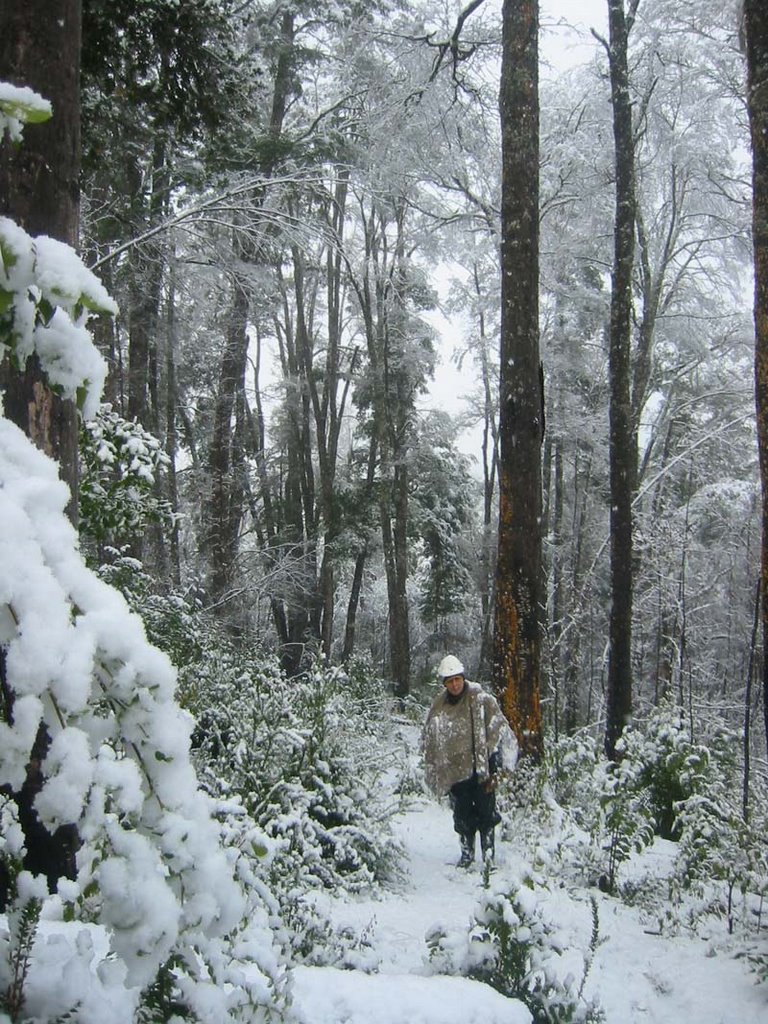
We started in the meadows and climbed to a forest of moss-covered boulders dubbed the houses of stone, up a river valley to huge southern beech and thick stands of lenga and ñirre. Lolo walked attentive to surprises in our path: a blue mushroom, a giant spotted moth, a rock in the shape of Easter Island moai.

Given the storybook setting, I would not have been surprised should we happen upon wood nymphs or trolls. Light streamed through the forest in glittering pillars. Big trees grew straight out of granite hunks. The river was transparent and ice cold. I’m telling you, it was that good.

And if there were no gingerbread house at the end of the trail? At least we packed the cherry preserves.


July 15, 2005

greetings Winter

“This one had his two feet in the grave!” Doña Licha’s great doughy hand flopped at her octogenarian husband. A month ago in this bad Patagonian winter he’d fallen on a rock going out for firewood. Six days later was helicoptered into the city hospital with broken ribs.

Leonidas Pinto, the exhibit under discussion, squinted at me and nodded. It was true. He liked to cross his arms over his chest, but today his hands were folded in his lap. Six days?

“Without a word. And almost a week it took him to admit it.” Doña Licha’s baritone voice resonated in their bare kitchen, decorated with grandkids’ soccer trophies and various rodents and raptors which had undergone amateur taxidermy. Cozy it wasn’t, at the end of the valley, in a worn farmhouse under the glaciers.

To boot the goats were dying—they’d managed to sell off the calves but their remaining animals had neither shelter nor sufficient grazing. Buying supplementary feed was a great cost for these poor subsistence farmers, one that they might not need to incur if the winter came rainy and gentle. This one didn’t.

Chile is having a killer winter. Rain or snow filled the entire month of May. On May 20 over forty soldiers marched to their death on the flanks of Antuco volcano because their commander ordered to change posts despite blizzard warnings. The government (it is an election year) is sending aid to its isolated residents, like the Pintos, which included feed for the animals and some for the people too. A couple of bales of hay dropped by helicopter might not make much of a difference if it keeps snowing. I love the snow; prefer it a hundredfold to the constant southern rains, but ranchers feel differently. Snow is death.

One rancher had lost up nineteen sheep to lingue, a plant poisonous to animals, but attractive when there’s little else to forage. Trips to get medicine were out of the question and things like meat, dairy, fruit and vegetables were scarce. People ate dried meat, fry bread, potatoes. The Pintos had recently sacrificed a horse with a broken leg and the maroon strips were salted and strung up like Christmas decorations throughout the house. The animal had belonged to their oldest grandson, Johnson. He moped and stayed away.

In these conditions I went out to make my last visit to the people of Ventisquero Valley, seeing what wasn’t there in summer. Couples who had been holed up alone for a month snapped and crackled when butter was requested. Hairbrushes were forgotten. Knitting needles clicked. Dogs were real thin. Midday folks looked out their small windows guessing which dim mountain their animals had retreated to.

I admit I went because I had heard about Don Leonidas’s accident. I was afraid he might be dying. There were signs—his grown daughter grabbed a photo I’d offered her father of the two of them, “as a remembrance.” Doña Licha said that she wouldn’t step foot in a hospital again, that you went there to die, and even that you couldn’t do so well in those places. Don Leonidas took advantage of his new frailty to tell me he remembered nothing anymore, so went my questions of the old days.

Instead of prying I ate some fry bread with instant coffee and had a real visit. Doña Licha got stirred up and said she’d cook a goose if I came the next day. Would I? Everything depended on the reprieve of bad weather, and I was sure it wouldn’t happen. “Don’t you get it?” Don Leonidas said from his shaded corner, long unnoticed by all. “The girl’s trying to say goodbye.”

“The fox” they called him. I was convinced then that his wits were still sharp, but it was his game now, and he’d play it how he wanted to. But I was gaining on him too. If I asked he would send a grandson to show me the hidden trails to the pass. Maybe he would tell me about the old persecutions of the law, his wanderings to Argentina, his happenstance survival and the revolutions his mind took as he sat here in the half-darkness, with a whole hard life behind him.

I left before the darkness would catch up, promising to be back in spring.

January 31, 2005

route finding


Above Lago Azul

My other recent trip was an exploratory excursion into the box canyon of Azul Lake, looking for an ideal place to take hikers that wanted to earn birds’ eye-views through sweat. I was set to take two friends from the states, Stephen and Tara, along with fellow guides Cathy and Fernando. As fate would have it a terrible stomach flu claimed Stephen, and Tara as nurse nightingale, so the group was whittled down to three.

But we still had the gear (read: elaborate gourmet food and camp accessories) for five, or perhaps for eight. We hiked the perimeter of the lake on an old trail almost never used. The spiky brush of rosehips and hazelnut bushes and other plants had reclaimed the trail. We had to breaststroke our way through the underbrush, if one had worn shorts it would have been occasion to cry with all the needles and spines grazing our legs. As it was, the conversation was reduced to “ooh” and “ow.”

The next segment of the hike was up, straight up, at a merciless angle. But here there was an established trail, a good one, since livestock climbed these valleys in winter to forage for food. These were the so-called “wild cows” we stumbled upon, or, “spy cows” who gazed at us through thick forest brush and bolted like frightened sparrows at the sound of a snapping branch. All the while we lamented the absence of Stephen and Tara, who would have provided good humor and extra cliff bars.

The valley we climbed into was not the flat, high altitude basin I had imagined, but instead, a long steep walled forested canyon that ended in a wall of formidable peaks: the Argentine border.

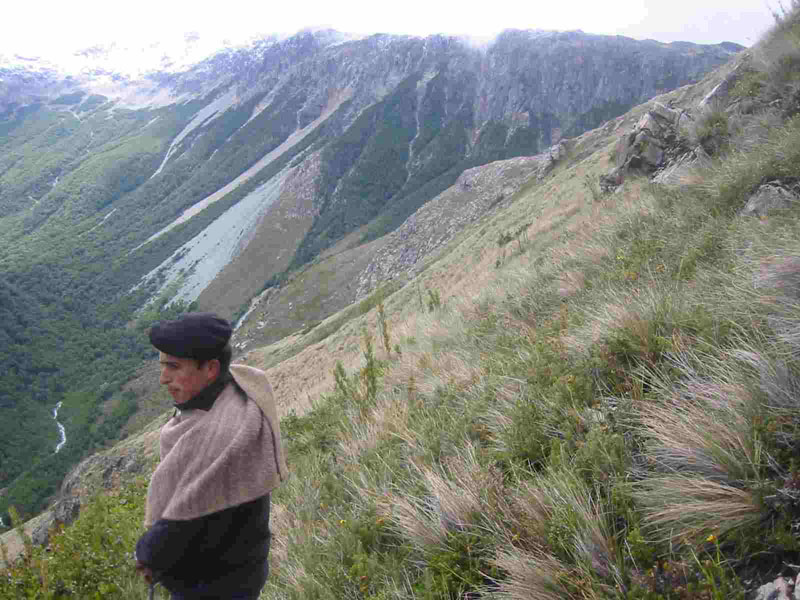
The next day, while it spit snow and hail, and the clouds banked low on the peaks, we had a look around the upper reaches on the only accessible mountain, which had burned in years past and now had short grass instead of forest. From up there we could see Lake Azul and the waves of mountain ridges behind it. The wall of Argentina still stood before us like a fortress, but now it seemed we had earned half its height. The trouble was getting down. We went route-finding, which is to say, wandered toward the back of the mountain, slipping all the while in the coarse, wet grass, before descending into thick brush that threatened to swallow us whole, or, mercifully, claim an ankle. Wading though the plants my boots absorbed water until it felt like I had sponges under my rotting feet.

To sum it up, Fernando, a local 20 yr. old, who ached for a military career and herded sheep and cattle all his life, said, “I never want to walk this way again.”

I wasn’t so sure. We heard of another local who has ranched and shepherded and knows the valley well. He says there is a better trail which leads up to the border, and he’ll take us there. I have gone to the pharmacy, undergoing the initial embarrassment of asking for a cream to cure the mushrooms on my feet (literal translation). They’re starting to heal up nicely. And once again, though half the time these trips result in uncertainty and mild torture, I find that I ‘m tempted.

These places will never lack adventure, they will always have places to explore, secrets to find. The cows know. I have a feeling, the way they eyed me suspiciously. And they want their secret kept.

the hidden valley

It seems like for the past year I have been treading the rural backwater, so to say that I’ve hit the furthest-flung reaches might sound redundant. But it’s not.

I had heard about Ventisquero (the hanging glacier) Valley for some time. I tried to go twice but was foiled. First in September by a horse accident, and second in December by a travel partner unwilling to trod the eleven hours in on foot. A local claims that the valley is bewitched and “mañoso,” picky: not letting just anyone enter, and sometimes keeping travelers at bay for weeks with storms and swollen rivers. In short, it sounded to me like the kind of place where folktales and fairytales were still being manufactured.

This time I took my time and contracted a local guide, the only who would agree to hoof it (walking is second class, riding is first). Still, we traveled with a packhorse to carry provisions and cross rivers with. We set out on a blazing hot summer day, horseflies swarming us as we made our way up valley.

My final destination, reached a few days later, was the ranch of Don Leonidas, age 79. He was the last of the old school of cowboys, arrived as a child in the valley and was brought up making a home out of the wilderness. When he was 22 he rode to Argentina to get a wife, and while before he was suspected to be a bandit, these days he is a local patriarch, the guy they send to the grade school once a year to tell the kids about the old days.

When I asked if I could tape him he took one sidelong glance at my silver recorder and asked how could he be sure it wasn’t a pistol. Sometimes being five foot tall and minimal works to your advantage. I just shrugged.

All the while an orphan sheep cried in the background (if they are bottle nursed they resist weaning and follow their owner around like a lapdog) and Doña Licha told me about her own milk miracle. When her daughter abandoned her granddaughter at their house she was able to breastfeed her, up until the sturdy age of eight. Doña Licha must be Ventisquero’s patron saint of dairy, she also showed me a separate hut where she makes cheeses and offered me a chunk of the mild stuff (like munster”), wrapped in an old plastic food wrapper, to bring home.

A gracious host, she hasn’t been out of the valley in at least twenty years (unlike her husband, who rides to town once a week). She says she won’t either, because she can’t get on a horse because of a hernia. When asked if she’d have it operated on, she replied in her baritone voice, “For what? Just let it be, I should be dying soon enough anyhow.”

On my second day their great grandchild, known as Juanito Accordeon (little Juan accordion) emerged from the attic, painfully shy but bribed by his great-grandma to play a few songs for a candybar. His instrument is an antique that he’d picked up lying around the house, and the keys stick in the humidity, making his little brow furrow.
Juanito plays accordion and guitar, mostly Mexican rancheras, and is seven years old. Doña Licha danced and slapped her thighs. The accordion appeared to crush Juanito, his two spindly legs sticking out, but he played with gusto, with the rapidity of a field mouse darting hole to hole. Juanito is the kind of kid that doesn’t talk unless it’s through an instrument, and then does so beautifully.

I have plans to go return to the valley in March, to get more stories and more cheese.

December 25, 2004

another one bites the dust

northern patagonia

One more year almost down the hatch. How are my friends out there?Somewhere I know there is winter, there are naked trees and frozen lakes, new babies, work, commutes, but so far away I can barely imagine any of it.

It doesn't feel much like Christmas with the hortensias in bloom, no jingles or pine trees in sight, and (in lieu of a turkey dinner) a lamb bbq this afternoon. American consumer madness has begun to make its way down here, but if you stay clear of the mall (one town over) there is not much in the way of frenzy. Me, I spent my extra dollars on phone cards. thank god I am not licking envelopes, but in the spirit of it all I am sending a Christmas missive of my own.

I have had a fortunate year and feel the need to celebrate a little that I remain in one piece. I plan to stay til the american summer. The plan is to travel during this excellent summer weather and write in the chilly months afterward. I have gained momentum with my project, recovered my ribs and lung capacity, become known in the mountains where I work, and rented a sweet little cottage (with spare bedroom for GUESTS) to make it all worthwhile.

I just returned from another trip to Patagonia for research. This time I went with an American photographer. We took a trip up to a glacier with a local guide, Lolo. He built the trail he built with his own hands, it's worthy of any in Rocky Mt. National park, with carpeted forests of moss and giant southern beech, thick sections of bamboo, a rushing clear river and southern beech. To give you an idea, the forests have the look of Japanese triptych, with whimsical fanning branches.

We never made the glacier. Snow fell both days we camped above treeline. My boots fell in the fire and suffered 3rd degree burns, as a result they shrunk, massacred my ankles on the hike out, then needed emergency "surgery" (via penknife) to refit. I am officially Bad Luck for anyone I travel with. We were able to have a good look around though, and ran into a wild huemul (a deer, endangered species) and a condor. We climbed a nearby ridge and saw the ripple of valleys in the distance, their blue-green snaking rivers and vast expanses of nothing.

People are the best part of these trips. Lolo lives with his sister and elderly parents in an elfin cabin visited by almost no one, it is so remote. His mother Odelia, age 85, puts on stacks of jewlery and her best dress for a visit, then sits and holds your hand. Guests are so scarce in these areas that hosts can tell you stories of ten years worth of visits-the time the German came and we traded chocolate bars and hard salamis for hand knit slippers and quartz crystals. My visit will be the story of "the time we installed the first shower." It was in a stall outside, and functioned with a bucket and very little water pressure. To shampoo my hair I had to bend over. I am sure they'll work out the kinks.

On my last visit I ran into a local who almost fell off his horse giving me the customary kiss hello. He was known as rarely sober. During my stay he turned up missing--his horse saddled and trapped on a raft mid-river (with a pulley used to cross the Puelo, a wide river with heavy current). They sent out divers and organized a search but have decided he has drowned. He is the most recent in a series of drownings, almost every family has lost someone, every crossing has a cross and plastic flowers in rememberance.

With the coming of the first road to the region this place is undergoing massive change. Seeing it first hand, I can imagine what the world was like for our parents or grandparents once and why they so mourn the changes. Every time I return, the footpaths I once walked into the mountains have become gaping sores of gravel (see pics combo and combo 2--taken of the same hillside 6 months apart). With the sense of isolation and community changing in great strides I have plenty of work left to do and will do my best to figure out what it means and to put it into words.

April 20, 2004

rural boarding school


Northern Patagonia

The Llanada Grande Escuela Internado is only two years old, and in pretty good shape. The only things its missing is a gym and heat. For physical education all grades, 1-8, run up and down the corridor that connects all the classrooms, or shove their desks in the corner of the classroom for stretching. All the classrooms are equipped with small cylindrical wood stoves, fed sporadically by the teacher while she tends to writing on the board or circling among the kids. One kid wore a pair of gardening gloves to class, not a bad idea. I had long underwear and a jacket on all day and still managed to freeze most of the time. Half the kids wear plaid or tan coats, uniforms, and most wear slippers or woolen slipcovers over their shoes. Thirty pairs of black rubber boots stand outside the front door. I have no idea how each kid finds his own.

Approximately thirty kids live at the school for the duration of the school year, whose boots you won’t find outside, since they live in bunk rooms in the building, their homes a matter of hours away by trail, the furthest valley being Ventisquiero (Glacier), where the kids must travel a full day to get home. It makes it hardly worth it to go home on weekends, and some of the kids are left for the year, while others go home all the weekends that the weather holds up, which become fewer and fewer as winter comes on.

The school is lacking so much of everything. Most of the teachers teach two grades at a time, dividing their class in two rows. Because of the scarcity of books the 5th/6th grade teacher had students read passages silently which they picked from various models and editions of reading books and comment individually about them. Another teacher photocopied small bits of text which the students pasted into their notebooks, which then became a sort-of textbook. One teacher lectured, “the problem here is comprehension. So when you read, pay close attention.” Unfortunately, a third of the class couldn’t read.

The students aren’t typically allowed to bring books home. One teacher said, “I can’t count the times we’ve loaned a book and it disappears, then you visit the house and find it in the bathroom, being used as toilet paper.”

I expected a certain amount of claustrophobia, for the confinement, the rain, the lack of space and privacy. What I found was confirmed later on my bus ride out the valley, when I was one of two passengers, and put between the driver and his other passenger on the front seat, and between their conversation, instead of sitting in one of the various empty benches in the back. Proximity wasn’t shunned, it was savored. The girls of third and fourth grade adopted me immediately. They grabbed my hand when they saw me in the hall and snuck touches of my hair. I felt like The Beatles or Nicole Kidman.

The downside of being so special is my every move was broadcasted. I got lost coming home from school to the farmhouse one day. There are no streets in Llanada Grande, a few mud-bogged oxcart trails that end in houses, sinewy paths that meander and loop around straight-shot destinations. Instead, everyone takes the footpaths, which are a little distracting, crossing log cattle fence ladders, the re-paved municipal airstrip, fallen limbs over streams, flocks of ducks, piglets, horses, thick forest, open, ruddy farmland, thick, low forest, pegged wooden gates and fences.

Of course I wasn’t really lost, because I saw the landmark waterfall nearby, but I had roamed back and forth in the fields and the forest and still hadn’t found the farmhouse. Finally I headed for the house under the waterfall and a woman collecting wood gave me directions.

The next day at school a little girl came up to me. She turned out to be the wood-collector’s daugher. “You got lost yesterday?” The question was more puzzlement than inquiry. It drew the other kids closer like magnets.

An army lieutenant thought he saw my horse being prodded by another rider on the trail a few days back. “Impossible,” I tried to convince him. It was no use. Tourist season had ended, there were no other blondes to take cover in. Llanada knew me now.

Of course, like any other place it holds its secrets. But I was surprised to find the kind of stories that became public fodder. One day at recess a kid named Leandro, age 11, played the guitar and sang for me. The principal’s office was packed. I was dragged to the scene by my girlfriends in 3rd grade, who had set up the concert themselves, saying “there’s a kid who can play guitar and he sings about the guy who drowned in the Rio Ventisquiero.” Like a folktale, I thought. No, it had happened two years ago. They even dragged the little sister of the guy to the concert, saying, “She’s the one who lost her cousins.” The girl nodded sadly. I tried to offer my condolences while the music started—Ranchera—which has a huge following in rural Patagonia.

Little Leandro played a mean guitar, but he didn’t author the lyrics. Those were penned by a guy in the valley. The tragic song about the son and husband that was lost in the flooded river when his horse slipped was followed by one about a drunk man who goes to jail for killing another man (also inspired by true local events) and one about a man attempting to make conjugal visits to a married woman. I didn’t even ask about that one.

The kids of Llanada Grande escuela internado clapped along and cheered to the songs, their stories, of their valleys, which everyone knew by heart and counted among their few possessions.

April 16, 2004

the middle of everything

Back from a rainy, muddy, week in Northern Patagonia in the mountains (or “cordillera,” a term I prefer for its precision and the corduroy sound about it). Anyhow, after several trips to the upper Puelo I’ve found something unexpected. The middle of nowhere is becoming the middle of everything.

Llanada Grande is about 140 km south from Puerto Montt, the capital of Chile’s X Region. Until this past year the village only had an airstrip and a network of trails that could take you and your horse to the city in 12 days, descending parallel to the flat, turquoise River Puelo. Last year the road was finally put in, so now, via vehicle and ferry combinations, the village is seeing more and more traffic. While staying in a farmhouse there this past week I ran into a Tango performer based in Toulouse, was interviewed by a Chilean film crew making a show on fly-fishing and traveling with models, and met a collection of local kids in the public boarding school struggling with poverty, low-funding and scandals.

The major achievement of my trip was learning to ride at a gallop, not achieved by my own election, but rather, with help from a friend bored with the pace. My horse was “motivated” by a slap on the hide whenever Oscar would pass, or a smoochy sound that drives horses wild. We made a four-hour trip in three, me laughing most of the way in sheer terror.

That was Easter, a dark and chilly day of mud and rain, rewarded earlier by a lamb barbecue at a local’s farm and chocolate bunnies for the kids, who found prodigious appetites for the new discovery. In a place where the nearest church was hours away and only open for business every few months when the traveling priest was in town, the date was barely observed beyond a mere acknowledgement, “it’s Easter?” “Happy Easter.”